Subterranean termite colonies thrive in the expansive clay soils common across Harris, Fort Bend, and Waller counties, where shifting ground creates minute expansion fractures along residential slab-on-grade…
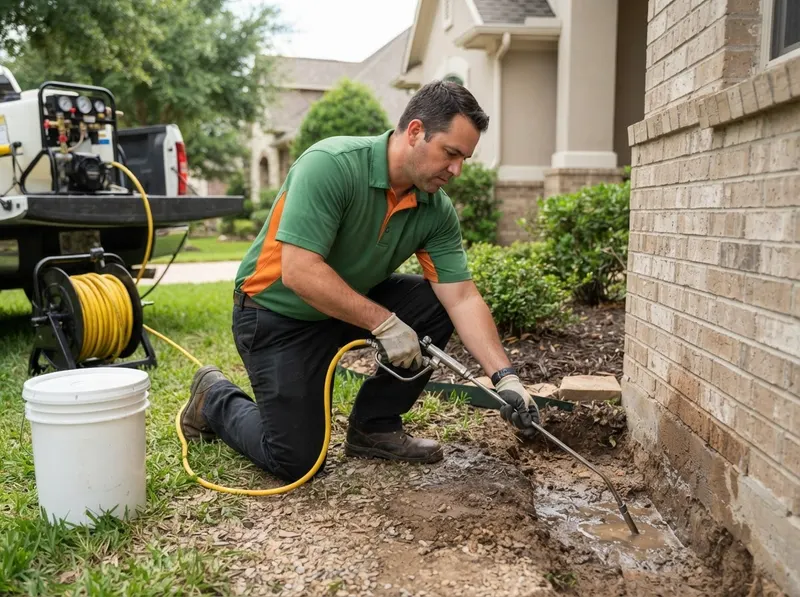
Subterranean termite colonies thrive in the expansive clay soils common across Harris, Fort Bend, and Waller counties, where shifting ground creates minute expansion fractures along residential slab-on-grade foundations. In master-planned Katy communities like Cinco Ranch, Firethorne, and Cane Island, exterior brick veneer homes feature ground-level weep holes positioned mere inches above finished grade. When lawn mulch, patio pavers, or landscaping beds breach the brick ledge, subterranean workers construct earthen mud tubes through microscopic brick gaps into hidden wall voids. An undetectable liquid soil barrier creates an continuous protective treated zone: foraging workers pass directly through non-repellent active ingredients such as fipronil, transfer the compound across the colony via grooming behavior, and eliminate the sub-slab nest without requiring broad, broadcast chemical spraying across open turf areas.
Selecting a perimeter soil treatment provides distinct structural protection advantages over localized bait stations. While perimeter bait stations require foraging termites to physically encounter a station every 10 to 15 feet, often taking several months to intersect, a direct liquid barrier completely envelopes the foundation footprint, stopping subterranean ingress at the structural envelope. The trade-off is mechanical: installation requires hand-trenching 6 inches deep by 6 inches wide along foundation perimeters, plus precision diamond drilling through adjoining concrete structures such as front entryways, Falcon Point pool patios, and garage aprons. These concrete injection holes are spaced approximately 12 inches apart and sealed with concrete patch compound, leaving the finished flatwork cosmetically restored and structurally sealed.
Installation follows a rigorous three-step physical sequence: 1. A physical linear inspection tracks every weep line, plumbing sleeve, and expansion joint across properties in developments like Elyson and WoodCreek Reserve. 2. Soil trenches receive four gallons of finished liquid dilution per ten linear feet per foot of depth, saturating the subterranean substrate down to the slab footing. 3. Attached masonry slabs are drilled and pressure-injected before the foundation soil is backfilled and tamped. Non-repellent liquid treatments bind tightly to soil organic matter, meaning rainfall and irrigation systems along Pine Mill Ranch and Grand Lakes will not wash the defensive envelope away or expose family pets and play lawns to mobile surface residues.
Every job gets a firm, written price after a free on-site visit.
Tell us about your subterranean termite liquid soil barriers job in Katy and we'll send a clear, written quote, usually the same day.
 Lone Creek Pest Control