Suburban residences across master-planned communities like Cinco Ranch, Elyson, and WoodCreek Reserve often feature expansive floor plans that allow bed bug populations to migrate rapidly through adjoining baseboards…
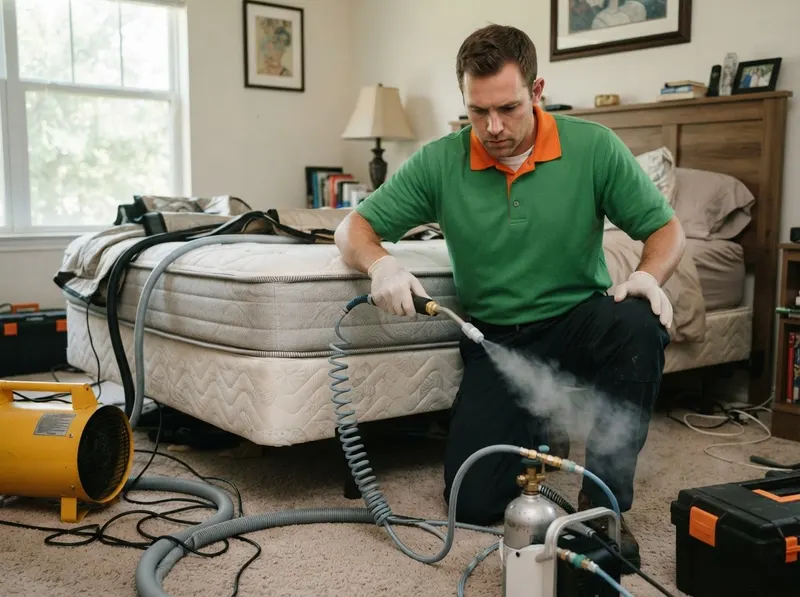
Suburban residences across master-planned communities like Cinco Ranch, Elyson, and WoodCreek Reserve often feature expansive floor plans that allow bed bug populations to migrate rapidly through adjoining baseboards and shared utility plumbing chases. Standard chemical sprays often trigger insecticide avoidance, driving gravid female bed bugs deeper into drywall cavities and insulated attic gaps. Structural thermal mitigation resolves this migration behavior by circulating controlled, forced air heated between 122°F and 135°F via commercial high-output thermal heaters, holding that core lethal temperature for a minimum of 4 continuous hours. Because thermal energy penetrates standard sheetrock, hardwood flooring, and dense memory foam mattresses, bed bugs and their desiccation-resistant eggs are neutralized in a single treatment cycle without leaving chemical pesticide residues on surfaces where children and family pets sleep.
Targeted cryo mitigation supplements structural heat by discharging liquid carbon dioxide snow at -110°F directly into delicate locations that cannot tolerate sustained high temperatures. In homes within Cane Island and Firethorne, sensitive audio-visual hubs, customized crown molding, modern smart-home switches, and fine musical instruments receive direct cryo spot treatments rather than thermal exposure. This dual-temperature approach replaces indiscriminate synthetic chemical drenches with a purely physical mode of action that leaves zero volatile organic compound (VOC) off-gassing behind. The clear trade-off is rigorous prep protocol versus chemical persistence: occupants, indoor house plants, vinyl records, wax candles, and oil paintings must be temporarily cleared or protected during thermal elevation, but living areas remain fully inhabitable immediately after structural temperatures normalize.
Executing bed bug remediation in Harris, Fort Bend, and Waller County homes follows a rigid three-step scientific sequence. Step 1 involves an envelope diagnostic check using high-resolution thermal imaging to identify structural cold spots, drafty weep-hole penetrations in brick exteriors, and hidden wall voids harboring active colonies. Step 2 requires setting up portable electric and indirect-fired heating units monitored by wireless temperature sensors positioned deep within structural dead zones, alongside simultaneous targeted cryo freezing of isolated items. Step 3 concludes with a post-treatment temperature mapping audit, ensuring every square foot of baseboard, bedding, and window framing sustained the required lethal thermal exposure. This process requires no multi-year recurring service contracts, delivering objective eradication rooted in structural physics.
Every job gets a firm, written price after a free on-site visit.
Tell us about your bed bug heat & targeted cryo mitigation job in Katy and we'll send a clear, written quote, usually the same day.
 Lone Creek Pest Control